Optus O Pavilion

Reorienting spatial relationships for an Australian telecommunications icon

The sprawling Optus workplace campus needed a solution to define the visitor journey and provide flexible opportunities for team connection. Architectus responded with the ‘O Pavilion’, which provides both a welcoming entry point and dynamic meeting place.

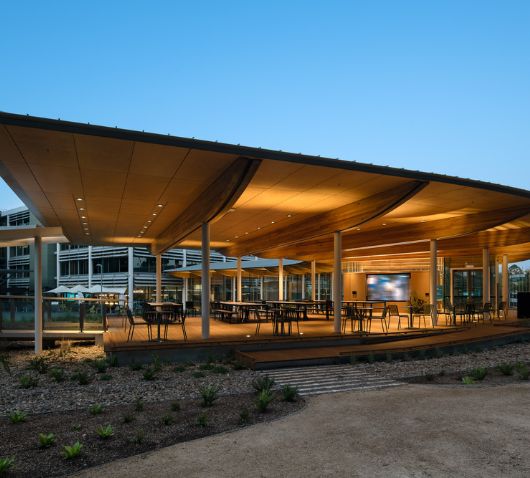
The O Pavilion’s striking roof form extends over the outdoor eating area.

A significant campus

The 80,000 square metre Optus campus in Macquarie Park, 13km north-west of Sydney, comprises 6 existing buildings serving 6,500 staff. Architectus were entrusted to rationalise, revitalise and embed post-Covid objectives and insights into the significant masterplan. Considering the project scale, Principal Patricia Bondin knew the symbolic and literal starting point of the journey was critical. ‘We started to think how we could bring new energy into the campus,’ she recalls. ‘Rather than taking away, could we augment the way in which the campus was experienced, inserting new energy and opportunities.’ The existing buildings lacked cohesion, and the natural landscape was underutilised – ‘Something you walked through, rather than appreciated,’ Patricia describes. ‘The arrival experience into campus was very anonymous with no particular character or personality. We conceptualised a new arrival pavilion to articulate the experience and make both visitors and staff feel more welcomed.’

Linear Tables and Benches were specified for their minimal, lightweight aesthetic.

A relationship-defining structure

The resulting O Pavilion is a striking point of reference, reframing the way the landscape dialogues with the surrounding buildings. New relationships are defined – between landscape and buildings, and between lower and upper parts of the campus. Shaped in a gentle curved language, the O Pavilion comprises a covered outdoor area and intimate internal landscaped area. Inside, a series of environments support a range of collaborative activities. Transparency is celebrated in both architecture and material, with a timber cassette structure and generous internal expanses with 4.5-metre clearances. Along with transparency, flexibility is embedded as a key strategy to support a future-focused workplace. Architectus have designed in ‘The capacity to choose the way you work on a given day – co-creation and collaboration meeting spaces that can also be reframed for presentation and dining. We’re hoping they can hack [the space] as they need.’


More workplace

The sleek silhouette of the Seam Cafe Table echoes the pavilion’s elegant aesthetic.

An aesthetic of 'light'

Seam Cafe Tables, Linear Benches and Linear Tables were specified for the covered outdoor area dubbed the ‘O Deck’, which can seat up to 250 people. Fully flexible, it can easily transform from casual smaller settings into a fully functioning, formal AV space, literally expanding the workplace outdoors. Patricia explains that the Tait products ‘Facilitated a beautiful sculptural lightweight layer that equally allows people to transform space as they need to. Coming back to that idea of agency, it felt like you could move the furniture, and own that space’. The Linear Benches and Linear Tables were customised with slatted compact laminate seats and tops. Whilst having an aesthetic impact, the slats also contribute to their stability in weather, as wind and air can pass through them without blowing them over. ‘We loved that they were light pieces in terms of their articulation, and they allowed that movement of air through the furniture. We felt they talked to the broader landscape story in a beautiful way.’


Custom fixing & weighting options

Linear Tables were also customised to integrate Cable Management Systems with pop-up power and data outlets.

Local manufacture: custom & sustainable

‘Being able to select furniture we know has been designed and manufactured locally is important,’ Patricia says. ‘It lowers the overall carbon footprint of the project, and you have direct access to the manufacturer, which makes the process of sampling really easy.’ For the O Pavilion, Linear Tables for the interior were also custom specified with lockable castors and integrated pop-up power and data outlets. They ticked multiple boxes for Architectus: ‘Robust materials and ability to work at scale, reconfigurability with castors allowing the space to be adapted for various events, and customisable for working, meeting and collaborating.’


Explore collections

Volley Chair: lightweight, outdoor-suitable, and with an extended lifespan through its ability to be refurbished

Embedding value through longevity

The durability and life cycle of products also helps to extend the value of the design, and the client’s investment. ‘Should use case change over time, the product is not going to fall apart,’ says Patricia. ‘We know it’s robust – and can be repurposed, which is also important. Volley Chairs that were specified previously for other locations have been refurbished and relocated, which has been really successful.’ At the Macquarie Park campus, the O Pavilion has inspired new behaviours and opportunities for working in collaboration. Its proven a sensitive intervention with deep impact – an exciting starting point to the wider campus overhaul ahead.


See a rooftop refurbishment
Published 3 March 2026
Share

Latest Stories