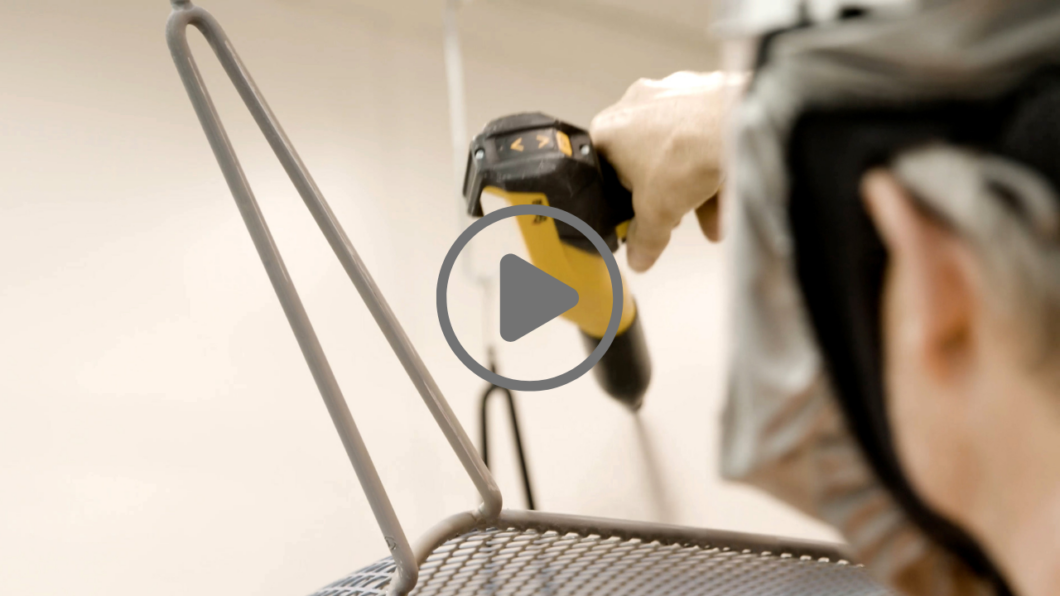

Applied electrostatically as a dry powder and then cured with heat, powder coating was invented around 1945. Used mainly on metal, it’s also applied to other materials like plastics, composites, carbon fibre and medium density fibreboard (MDF). It doesn’t need a liquid carrier like conventional paint, which results in several benefits:
-
Can produce thicker coatings without running and sagging
-
Produces a more uniform appearance
-
Emits few Volatile Organic Compounds (VOCs)
-
Allows for colour blending and special bleed effects in a single layer
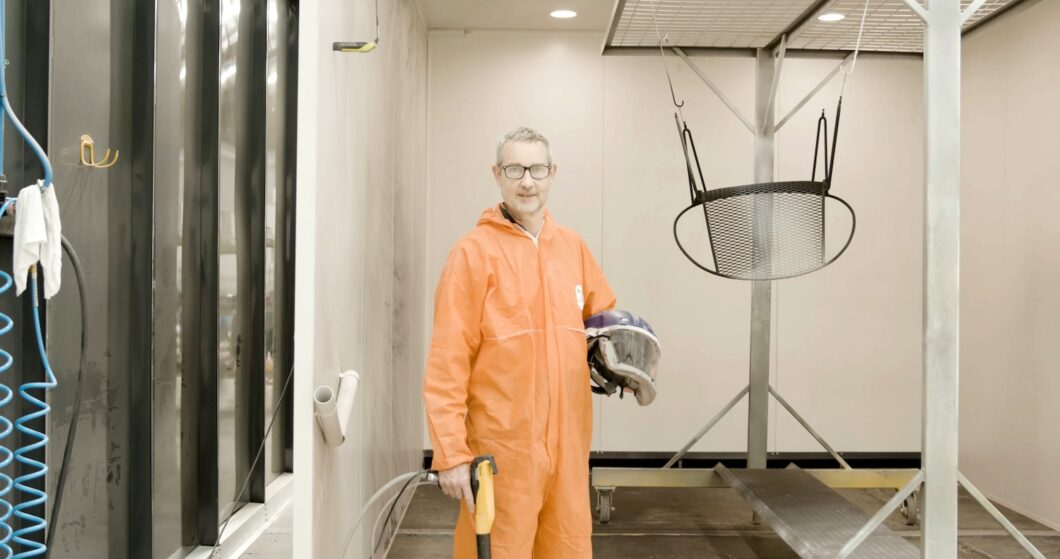
One of our past powder coating specialists, in situ with a Volley Chair
Why we powder coat
At Tait, most of our products require a powder coated finish as a protective, corrosion-inhibiting layer, or decorative finish – or both. Metals have unique characteristics, which means different requirements when it comes to powder coating. So we use a slightly different approach depending on which metal we’re working with. Whether stainless steel, mild steel or aluminium, we’ve researched, experimented and tested to perfect the process.
Some metals require sanding or glass bead blasting to assist the powder coat to adhere to their surface. Others require priming or etching to encourage the surface to accept the powder coat. As our products are made to weather outdoor conditions, all our powder coating processes also require careful preparation to mitigate corrosion.
Read about our welding process
Tait material palette
Who powder coats – and where?
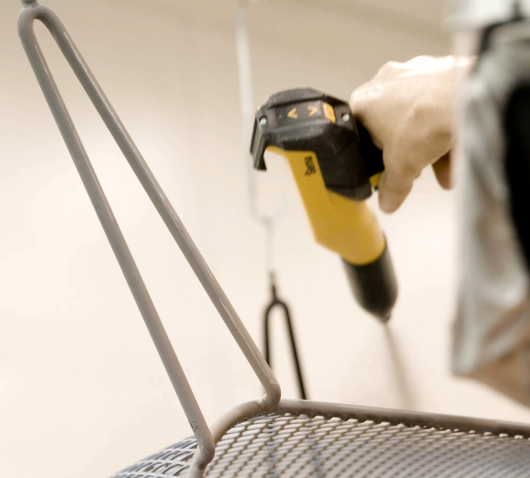
We have 1 powder coat application bay and 1 oven at our manufacturing HQ just outside Melbourne CBD. They are set up next to each other, to allow easy transfer of product from one to the other. ‘The powder is applied in the application bay and then transferred by trolley to the oven, where it is baked at 220ºC,’ our Founding Director Gordon Tait describes. ‘The trolley is then removed and allowed to cool before handling.’
‘Powder coat application requires concentration and learnt knowledge about how the different powders react to different metals,’ shares Gordon. In addition, ‘If a gloss finish is required, the pre-treatment of the part is crucial to the outcome.’
At Tait, there is generally 1 person who manages the powder coating for all the products we make. Our current specialist is Darrell Splatt, who completed his training in 2019 and has been with us for 6 years. Responsible for preparation, application and quality control, Darrell is immersed in the world of powder coating. He particularly enjoys ‘Achieving high-quality and durable finishes, and the satisfaction of seeing a finished product with a flawless and colour-consistent coating’.
‘All Tait products have different powder coating techniques and powder coating gun settings,’ he explains. In addition, very specific surface preparation, powder coat thickness and temperatures are required for an exceptional result. During quality checking, Darrell assesses and intercepts any defects such as peeling, chipping, bubbling, pinholes or floating particles. Having one specialist dedicated to this part of the process ensures the quality remains at a consistently high level.
Meet Amin, a welding specialist
How & when we apply powder coat
Besides the basic process of coating and curing, abrasive blasting is beneficial for mild steel as it helps the powder coat to adhere better. This is something we’ve also developed as an in-built service at our HQ, to reduce carbon miles and better guarantee the quality of the finish.
Having both processes under the one roof assists with critical timing as well. ‘If the sandblasted item is left overnight or near moisture it will immediately start to corrode and need to be blasted again,’ explains Gordon. ‘That’s why we always do the sandblasting and powder coating on the same day.’
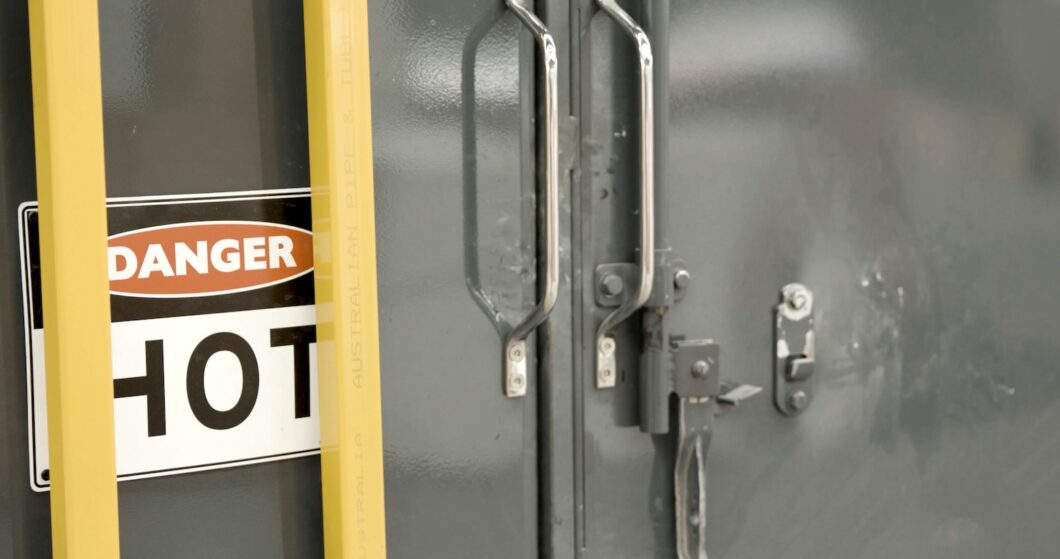
The oversized oven where the powder coat is ‘baked’ onto the furniture at 220º
Refurbishing powder coat
Despite its durability, powder coat is of course subject to wear and tear over time. ‘Once powder coat is chipped, it will never look the same after touching up – particularly in an obvious area like a table-top,’ says Gordon. ‘Scratches are very hard to conceal with a touch-up kit’.
So for refurbishment we generally suggest stripping the old coating off and starting again. This way you are ensured of a 90% success rate.’ Whilst it’s possible to apply powder coat directly onto an older, existing layer without stripping it can often give inferior results, so is not what we generally recommend.
Proper re-powdercoating, however, can extend the life of a product for many years. The hard-working Volley Chairs populating Melbourne’s NGV Garden (which hosts the annual Architecture Commission) have been re-coated to gallery-level perfection 5 times.
Watch: Making of a Volley Rocker
Latest Stories
NEWS
Order by 17 October for Pre-Christmas Delivery
Your made-to-order Tait outdoor furniture can be delivered before Christmas. Order by 17 October to set yourself up for A Life Outside this summer, so that your pieces can become part of your holiday season, and all the seasons beyond.
Read MoreNEWS
Complimentary Design Consultations
Take advantage of our free, expert design guidance for your outdoor space — in one of our showrooms or online.
Read MoreNEWS
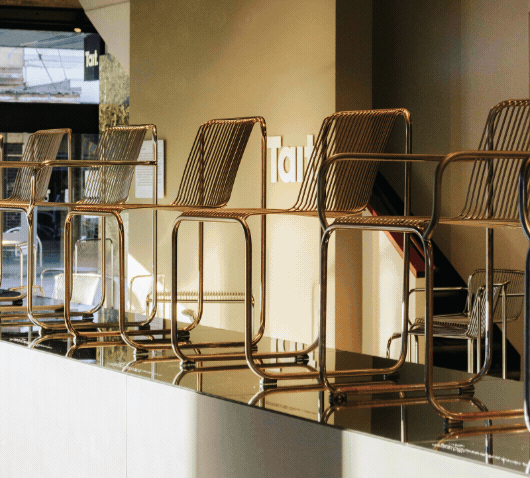
Melbourne Design Week Wrap Up
Get the recap of MDW 2026 at Tait, featuring the LUSTRE exhibition and launch of the new Swing Collection. Both have emerged from an obsession with metal – a restless, ongoing dialogue with stainless steel that sits at the heart of how we make things.
Read MoreNEWS
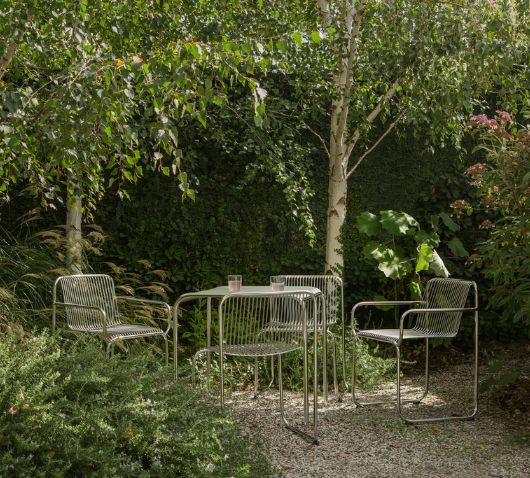
Introducing the Swing Collection
The beloved Swing Chair grows into a full collection. Expanding on the original’s graceful arcs, pure stainless steel construction and enduring craftsmanship, the Australian-made Swing Collection brings hardworking glamour to new seating forms and tables.
Read MoreNEWS
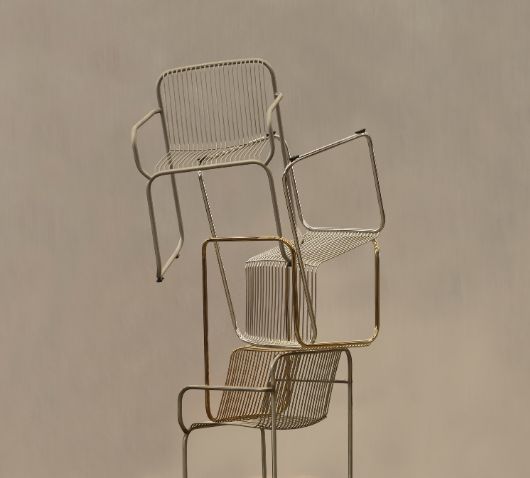
Experience ‘LUSTRE’ at Melbourne Design Week 2026
Stainless steel has much more going for it than its strength and seamless uniformity. The Tait Design Studio has been experimenting with this enduring material, with surprising results revealed at Melbourne Design Week (MDW) in the Tait Melbourne Showroom from 14–23 May 2026.
Read More